


Heritage Apartment
André Luque Arquitetura renovated a 570 m² apartment for a family in
São Paulo, focusing on the integration of social spaces.
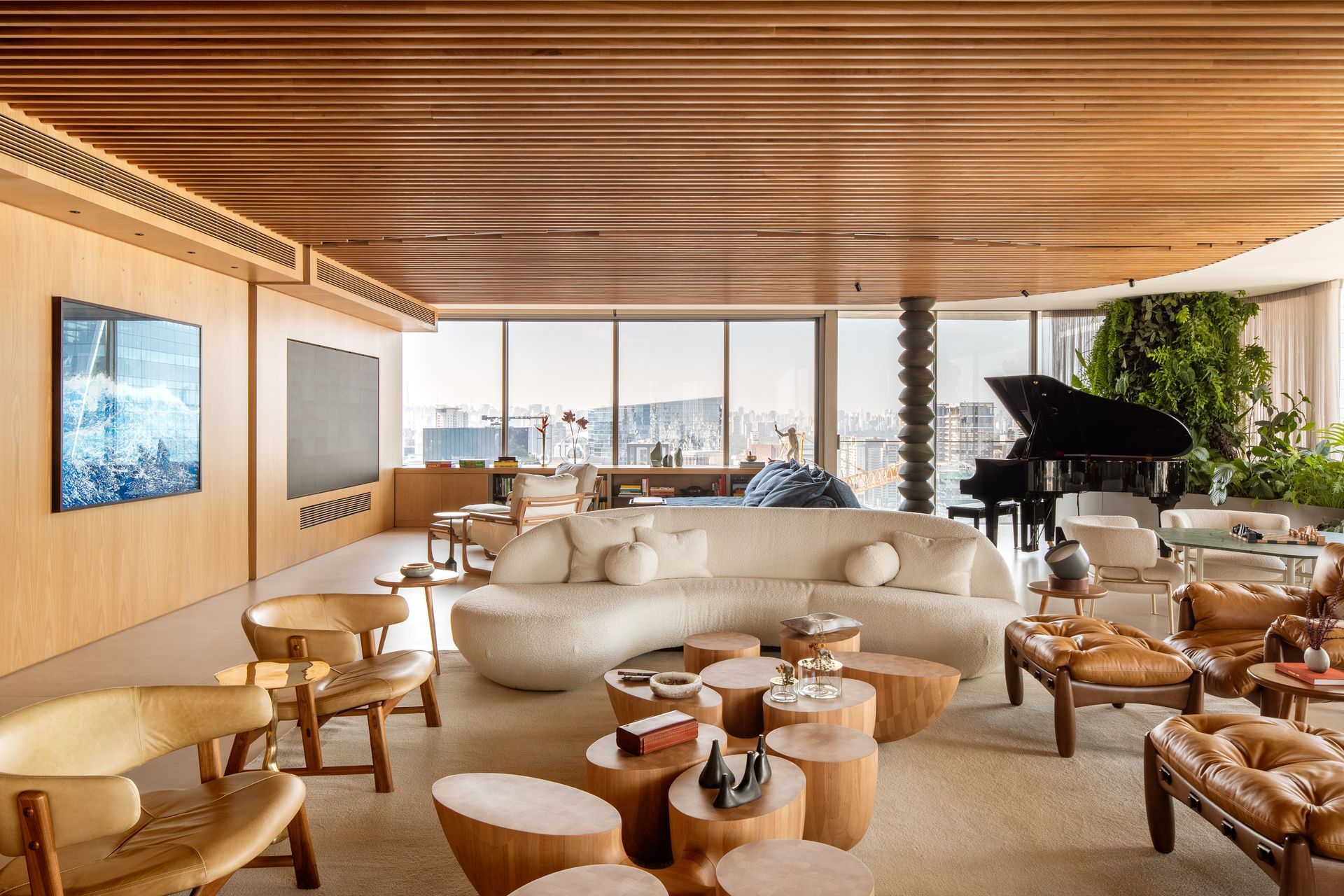
Located in a building in the heart of São Paulo, with the residential development designed by the Italian design firm Pininfarina, the Heritage apartment project – intended for a couple and their three children – proposes customized solutions to create a homely atmosphere. The 180-degree panoramic view reveals iconic landmarks on the horizon, such as the São Paulo Jockey Club and Parque do Povo. The brief for the renovation entrusted to architect André Luque, centered on the integration of social spaces, aiming to maximize the view and promote interaction among the residents. Another request was the inclusion of organic elements that echo the architecture of the tower. The walls dividing the social area, as well as the frames separating the living room from the balcony, were removed, and the flooring was leveled, transforming the social area into a continuous space embraced by the skyline.
The former balcony was fitted with new perimeter frames that span the entire facade, following a rigorous approval process from the building’s management for the installation of curved-vertex pieces, produced by only three companies in Brazil. These elements, which extend to the ceiling, glide along tracks embedded in the floor and, together with the guardrails, allow the breeze to flow freely when opened. This configuration enabled the residents to enjoy the sunset, something previously impossible due to the positioning of elements that obstructed the view.
To emphasize the flowing lines that define the building's design, the custom cabinetry and selection of furniture prioritize curvilinear forms, softening any potential aesthetic rigidity.
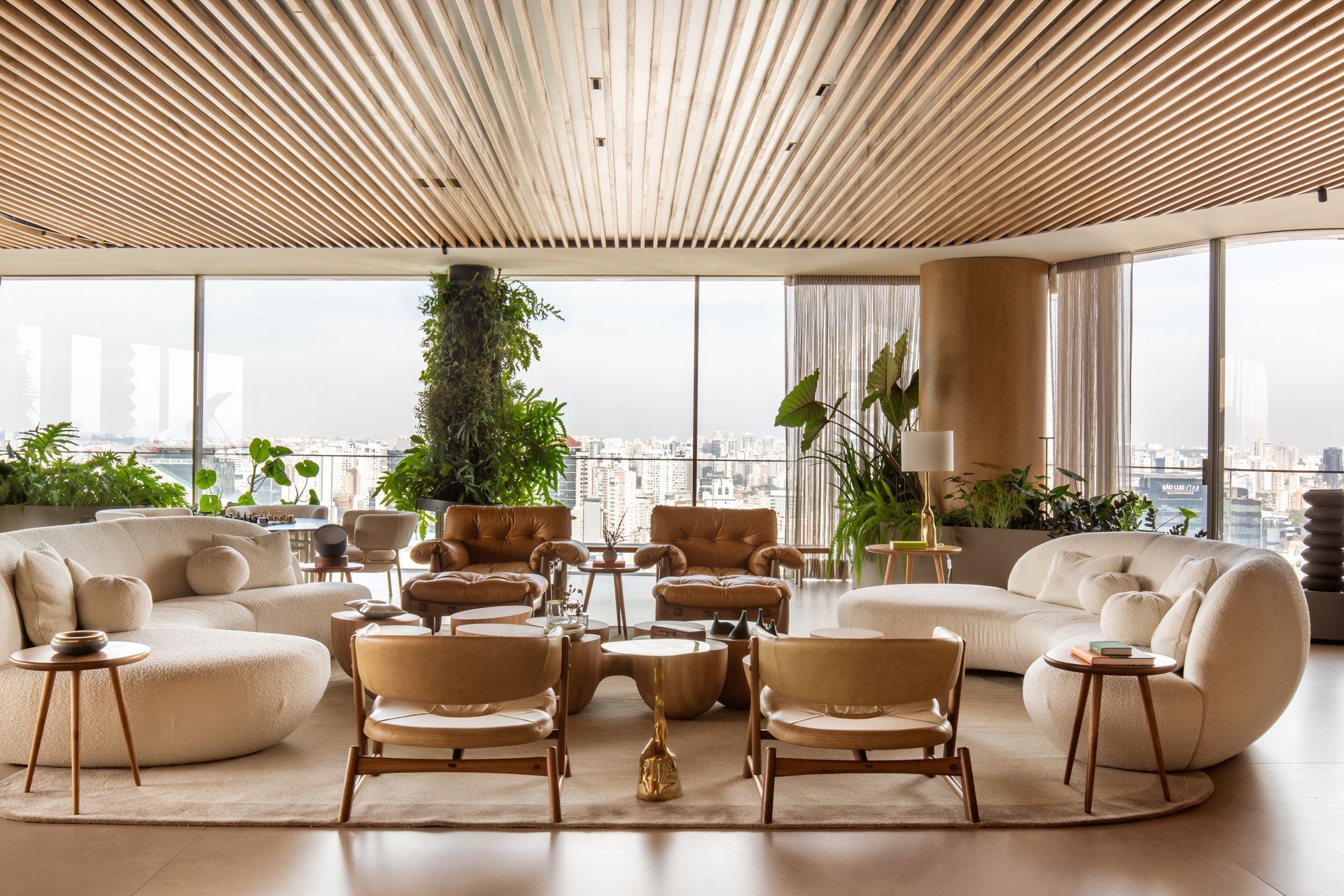
The visual unity is defined by the stone flooring that extends throughout the social area, as well as the ceiling made up
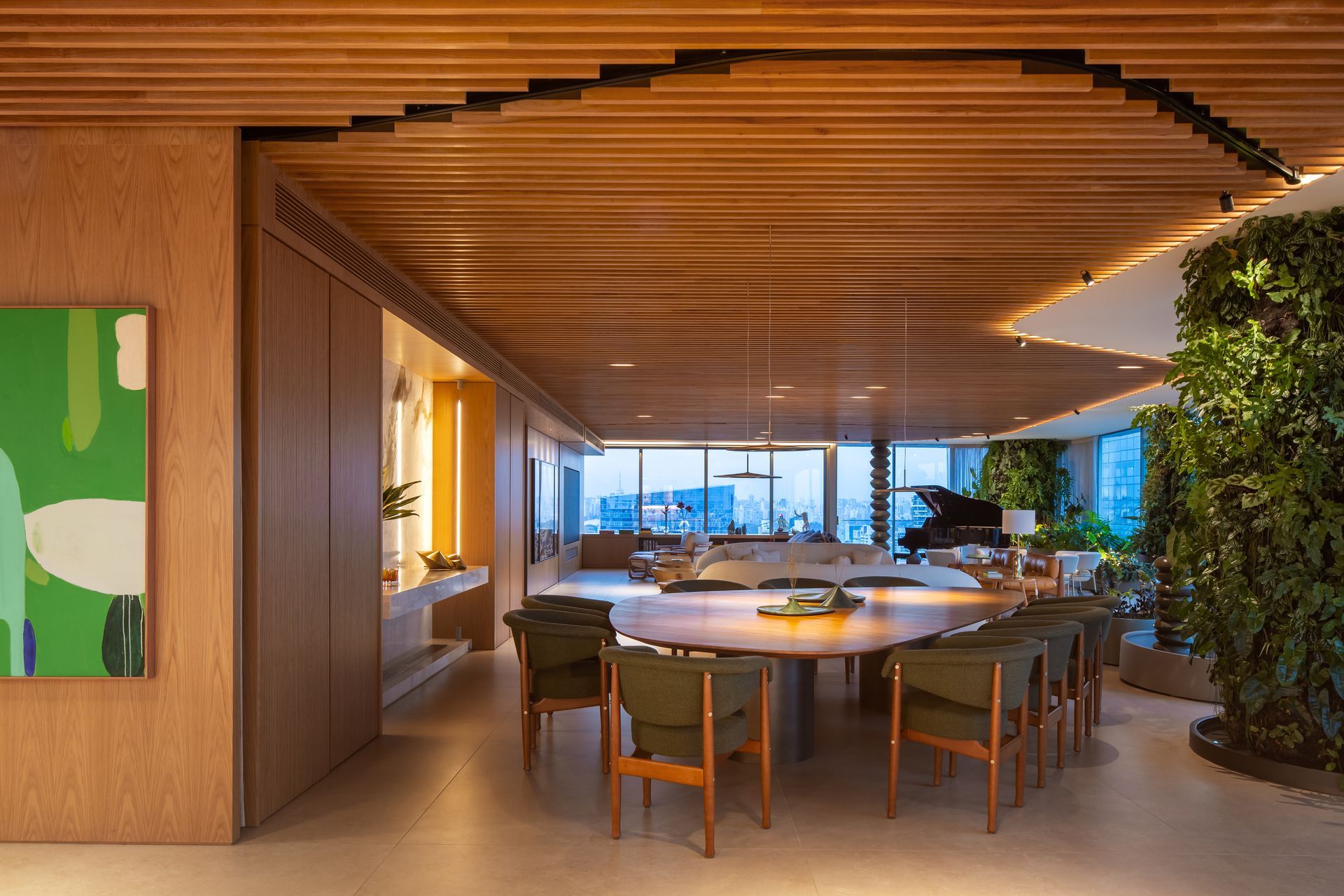
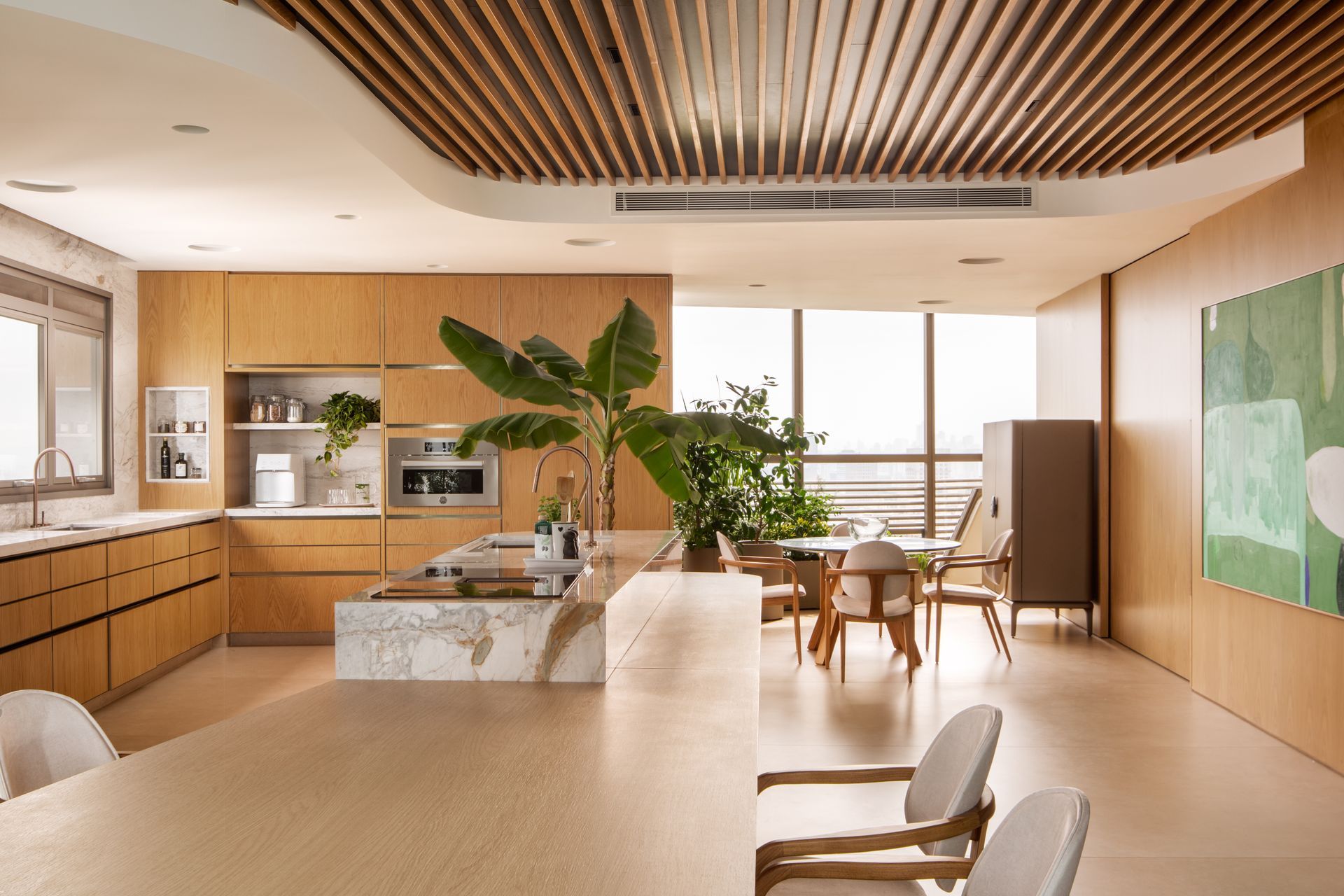
of wooden slats, each measuring 3 by 7cm, spaced 5cm apart. The original pre-stressed concrete slab had a total ceiling height of 3 meters, and the residents wanted to maintain this as high as possible. To address this, only the kitchen and entrance hall were lowered by 20 cm, allowing for the incorporation of air-conditioning systems, with linear grilles integrated into the architecture.
The wall surfaces are clad in American oak panels – the same finish as the ceiling – creating a uniform surface that wraps around the space and blends seamlessly with the cabinetry and doors leading to adjacent environments. The palette of natural materials enhances the welcoming atmosphere, while also providing a neutral base for the furniture and artwork.
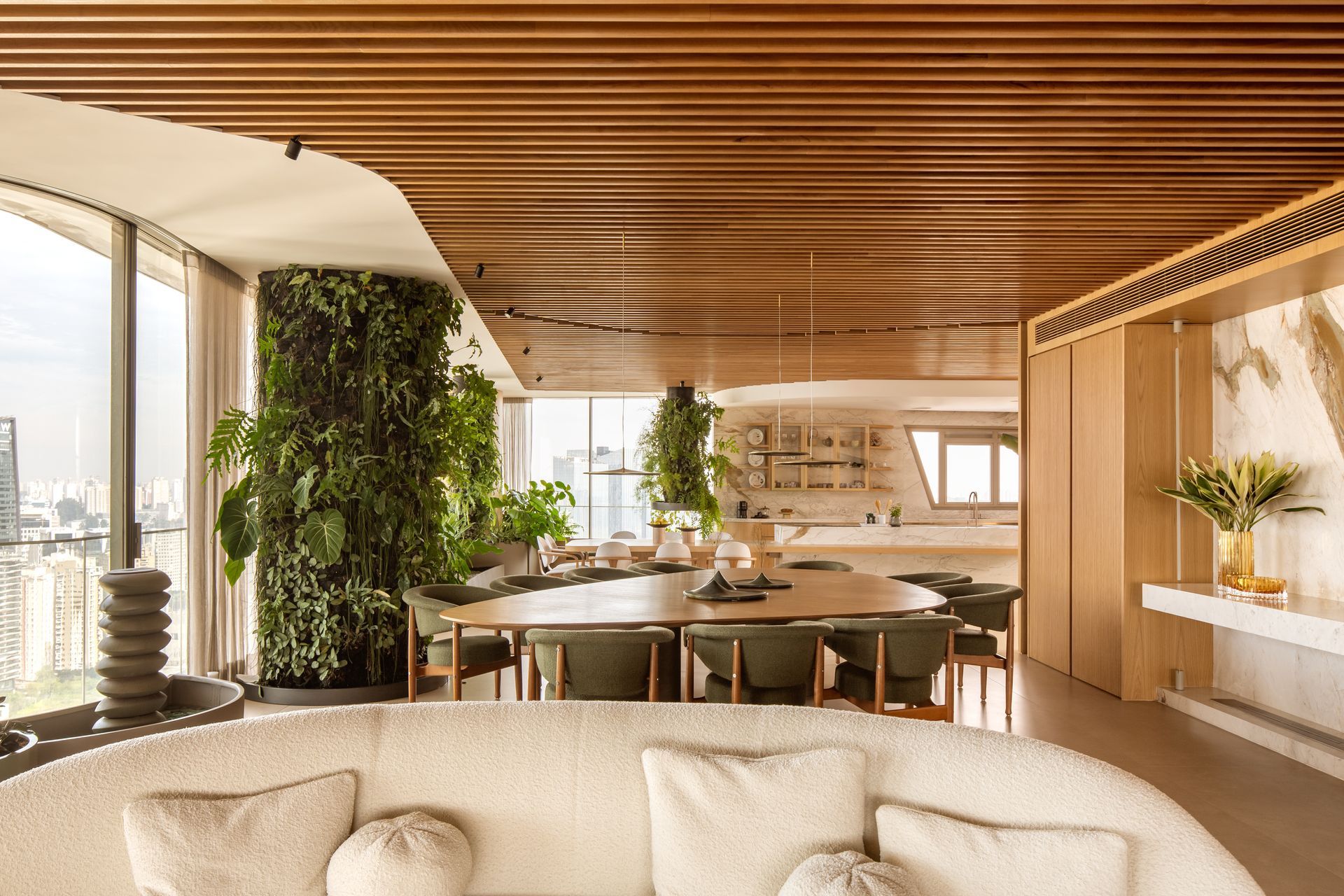
The social area encompasses, within the same space, the entrance hall, living room, game area, home theater, dining room, and social kitchen. To visually define each area, the furniture was arranged in a way that establishes the layout of the space. As a welcoming gesture, upon crossing the entrance hall – with its vertical wooden slat door and glass closure that fully recesses into the wall – residents and guests enter this private oasis. The central living room organizes the space: to the left is the home theater, while on the opposite side, the dining room connects directly to the social kitchen.
In the first project presentation meeting, the clients expressed to the architect the need to conceal the kitchen or completely isolate the areas to the main living room when desired. A flexible solution was sought, one that did not require a fixed architectural feature but still maintained the organic language of the design. A system of automated curtains was specially developed for the apartment. To preserve the fluid concept, the rail is shaped in curvilinear lines that interweave with the wooden slats of the ceiling, embedding themselves between the pieces. When opened, the fabric folds into the walls, making the curtains nearly imperceptible.
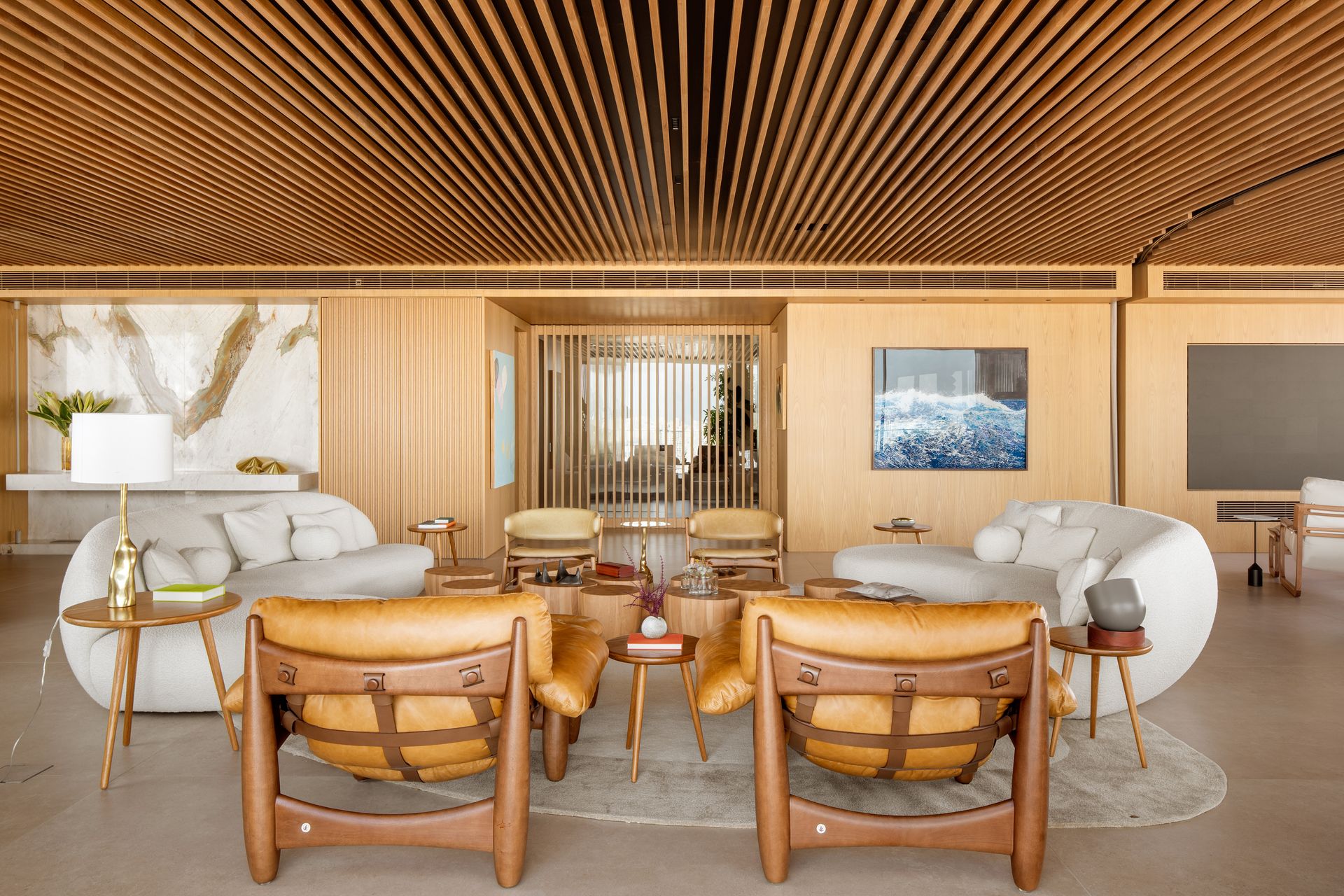
In the living room, the symmetrical arrangement of the furniture directed toward the center of the space, encouraging interaction among family members. The curation highlights Brazilian design, combining modern and contemporary pieces: the EOS sofa by Patricia Anastassiadis, the Sapão armchair and Kropf side table by Fernando Mendes, the Mole armchair by Sergio Rodrigues, the Roots coffee table by Jader Almeida, and the Cúrcuma side table and lamp in cast bronze by Cristiana Bertolucci. On the wall, there is a painting by artist Kilian Glasner. The voluptuous proportions of the pieces enhance the feeling of coziness, like an embrace, while also evoking an artistic character. Next to it, the Seixo table, accompanied by June armchairs by Jader Almeida, creates a space for board games, maintaining a lower proportion ideal for relaxed moments.
Bringing greenery indoors was essential to create the sense of "home." In collaboration with the landscape design studio Land N Citi, André Luque and landscape architect Rulian Nociti developed an original concept called "AtlânticaColumns".Thesecircular-sectionstructures, fixed to the ceiling, permeated by plant species, creating a suspended effect in the space. One of the building's original pillars received the same landscape treatment. These elements resemble tree trunks, offering a nearly poetic construction that blurs the boundaries between art and architecture. From a technical perspective, the metal tubes welded directly into the slab, and the electrical and plumbing installations – essential for the plants' life cycle – are hidden within the ceiling, requiring a rigorous coordination design. The plants housed in pockets resembling a vertical garden, and an automated irrigation system, with pumps running through the entire ceiling to the treatment station in the service area, keeps the plants hydrated. The discarded water is collected through metal trays.
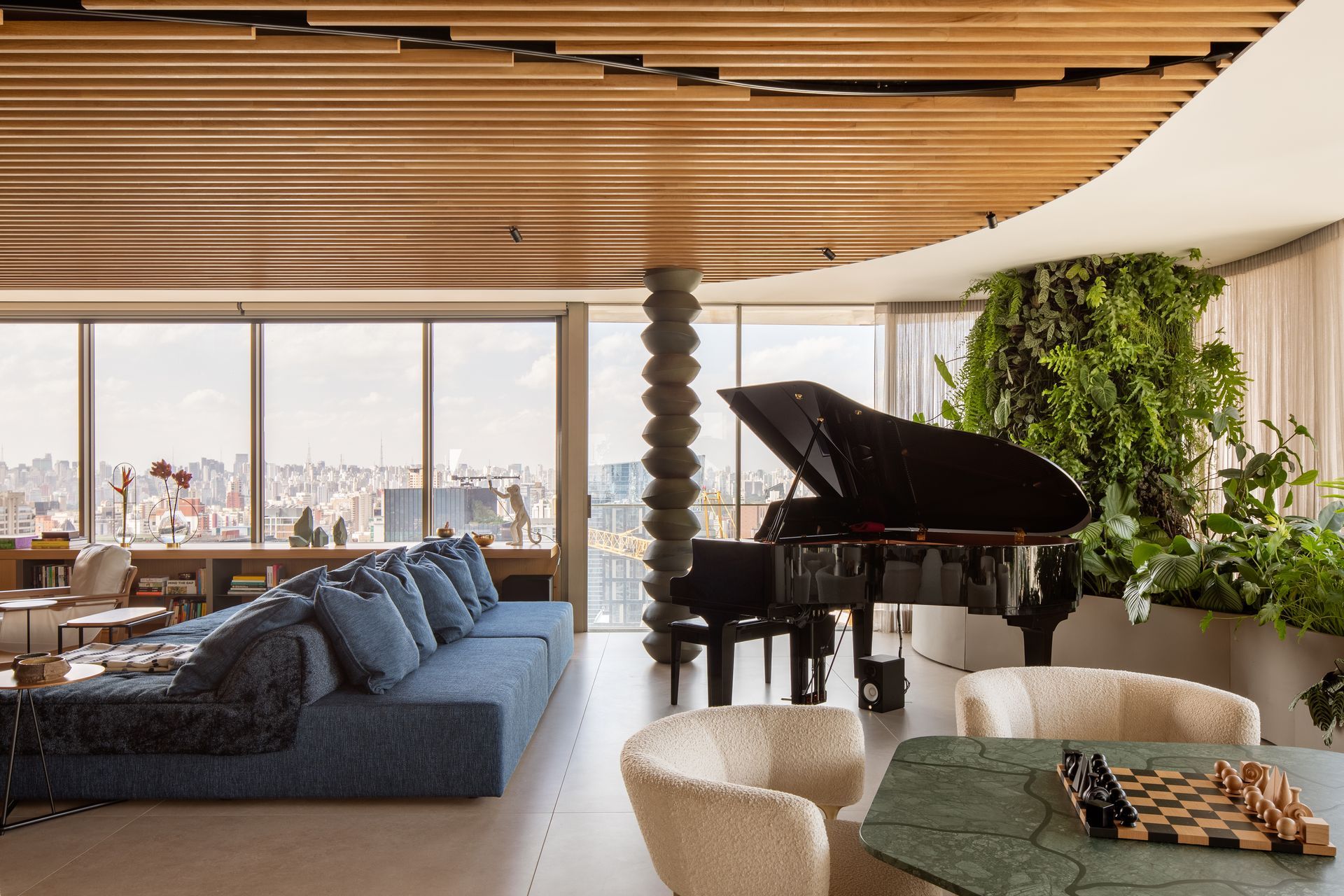
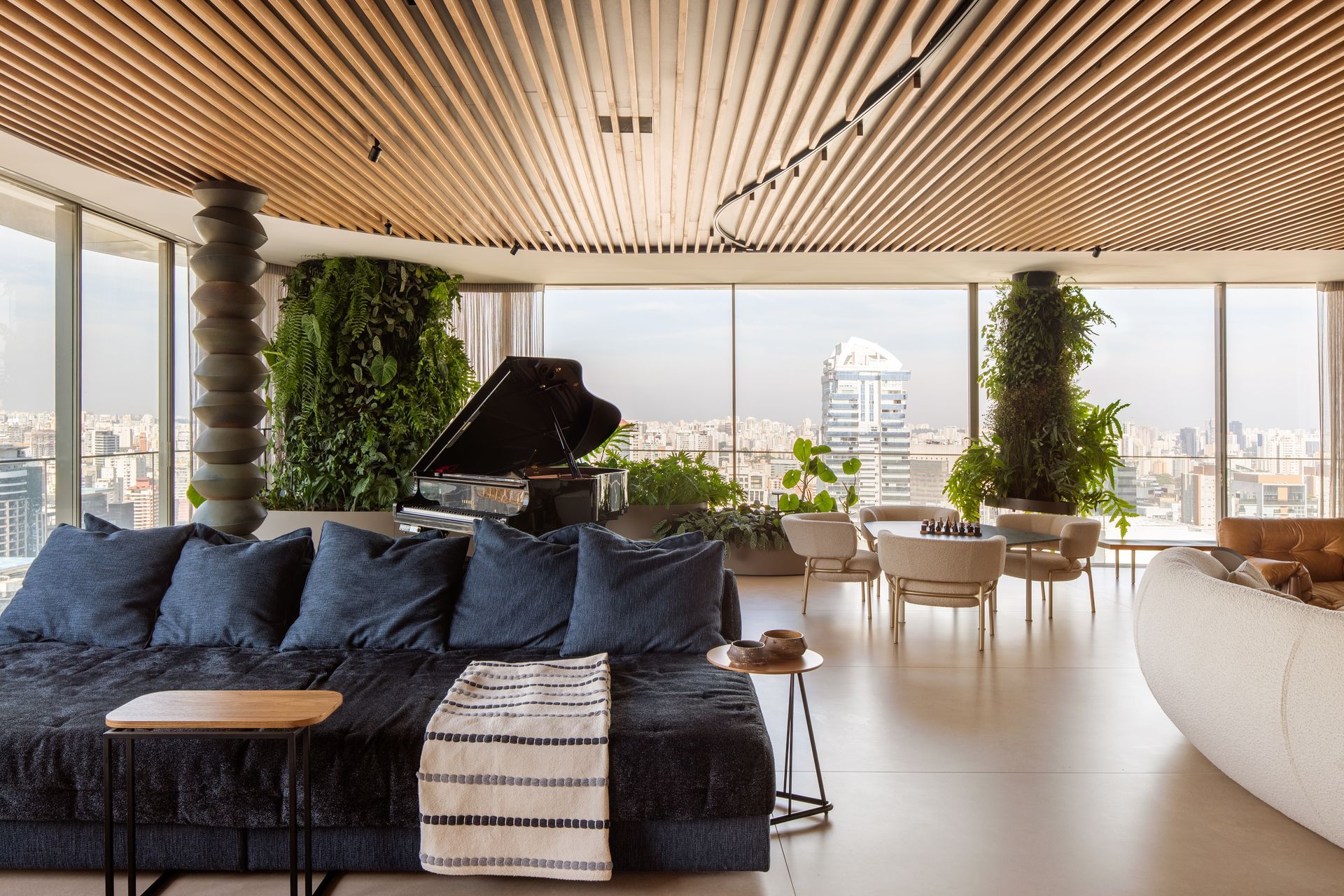
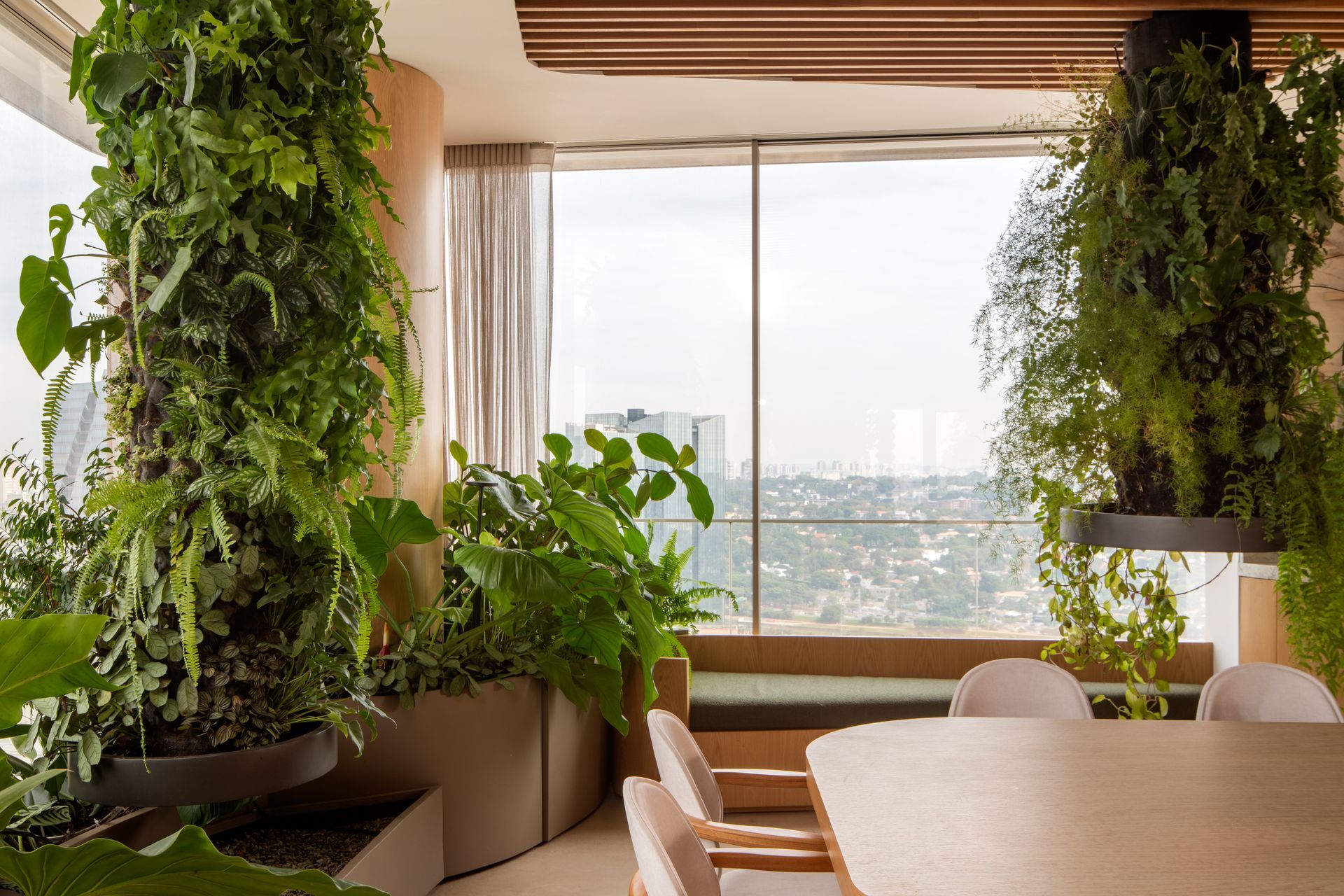
On the floor, metal planters of varying heights and organic lines partially snake along the apartment’s perimeter, surrounding the wood-clad pillars, made from a variety of tropical species. Custom-built benches provide spaces for contemplation of the view. At the architect’s invitation, Japanese ceramist Kimi Nii, who is based in Brazil, developed a sculpture for the residence. The artwork, which results from the layering of 13 ceramic pieces, forms a column that challenges the visual duality of stability and balance, resonating harmoniously with the "AtlânticaColumns".
To ensure high-quality audio and video, the home theater is equipped with LED panels installed over the wall panels, offering a cinematic experience at home. At the back, the grand piano – one of the design elements planned to occupy a central space from the initial concept – is highlighted by natural light, and the acoustic design allows sound to flow through the space withoutreverberation.
The dining room accommodates up to 12 people and features the Amorfa table, with a stainless steel base and natural
wood top, designed by Arthur Casas (Micasa), accompanied by Beg chairs, originally designed by Sérgio Rodrigues in 1968 (reissued by Dpot). Above, three UFO pendant lights, by Brazilian designer Fernando Prado (Lumini). A suspended sideboard, clad in stone, rests on a wall covered in the same material, while below, a gas fireplace provides warmth on cooler days.
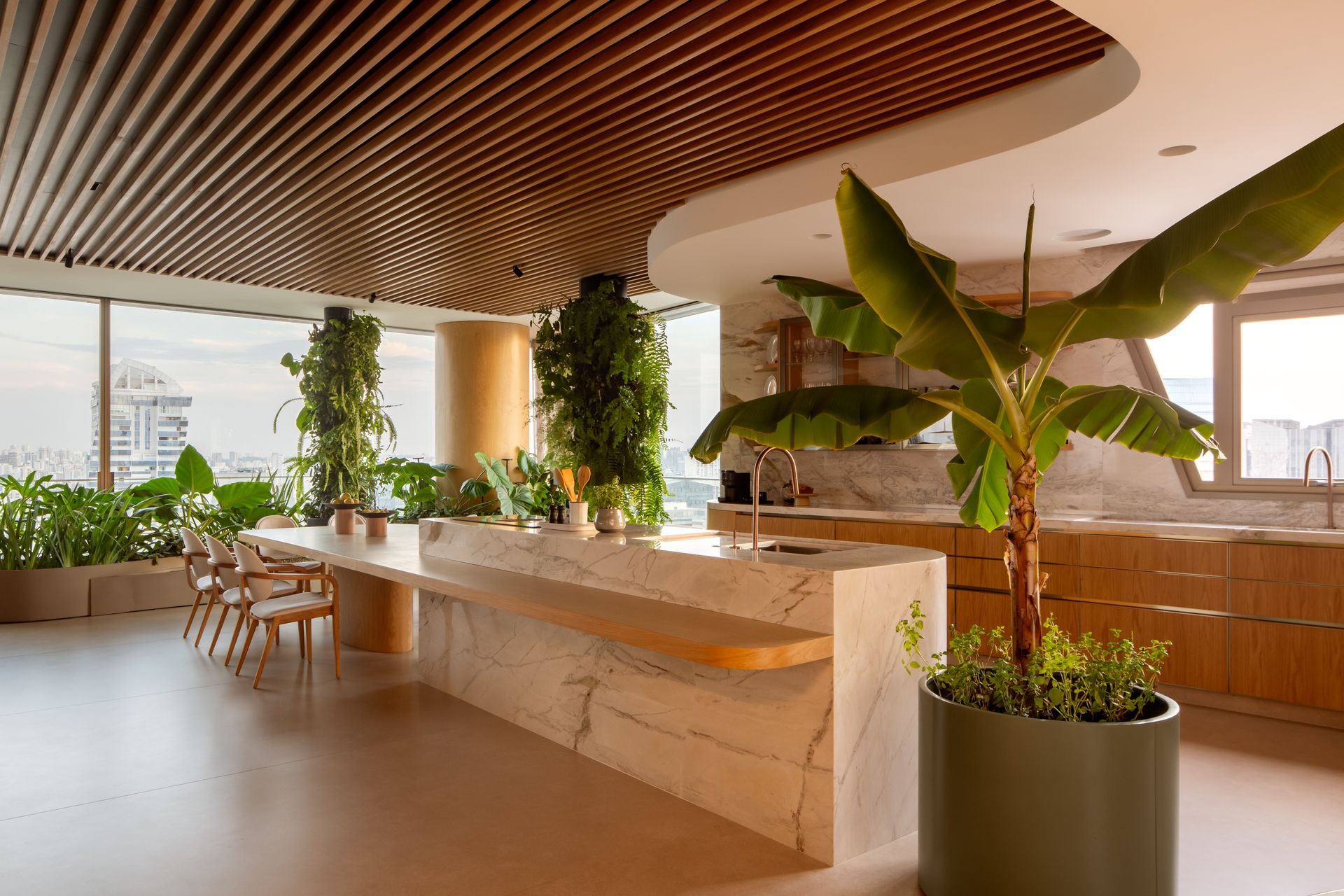
For the residents, who often host family and friends for social gatherings and have a passion for cooking, the kitchen had to be the heart of the project, just like the living areas. The project includes two kitchens: one technical, dedicated to daily use, more enclosed and hidden by a sliding door, and one social, open to the living areas, designed for festive days or entertaining. A central 6-meter kitchen island emerges as a sculptural piece. The varying heights serve both as a dining table and as a preparation surface for cooking. The highest section made from White Nuvolato marble, while the lower wood table rests on a helicoidal base. The surfaces of the walls and the countertop covered with the same stone. The custom cabinetry follows a strict plan in terms oforganization, solutions, and finishes, using wood veneers and brushed metal hardware. For quick meals, a round table completes the space, positioned beneath a window that benefits from abundant natural light.
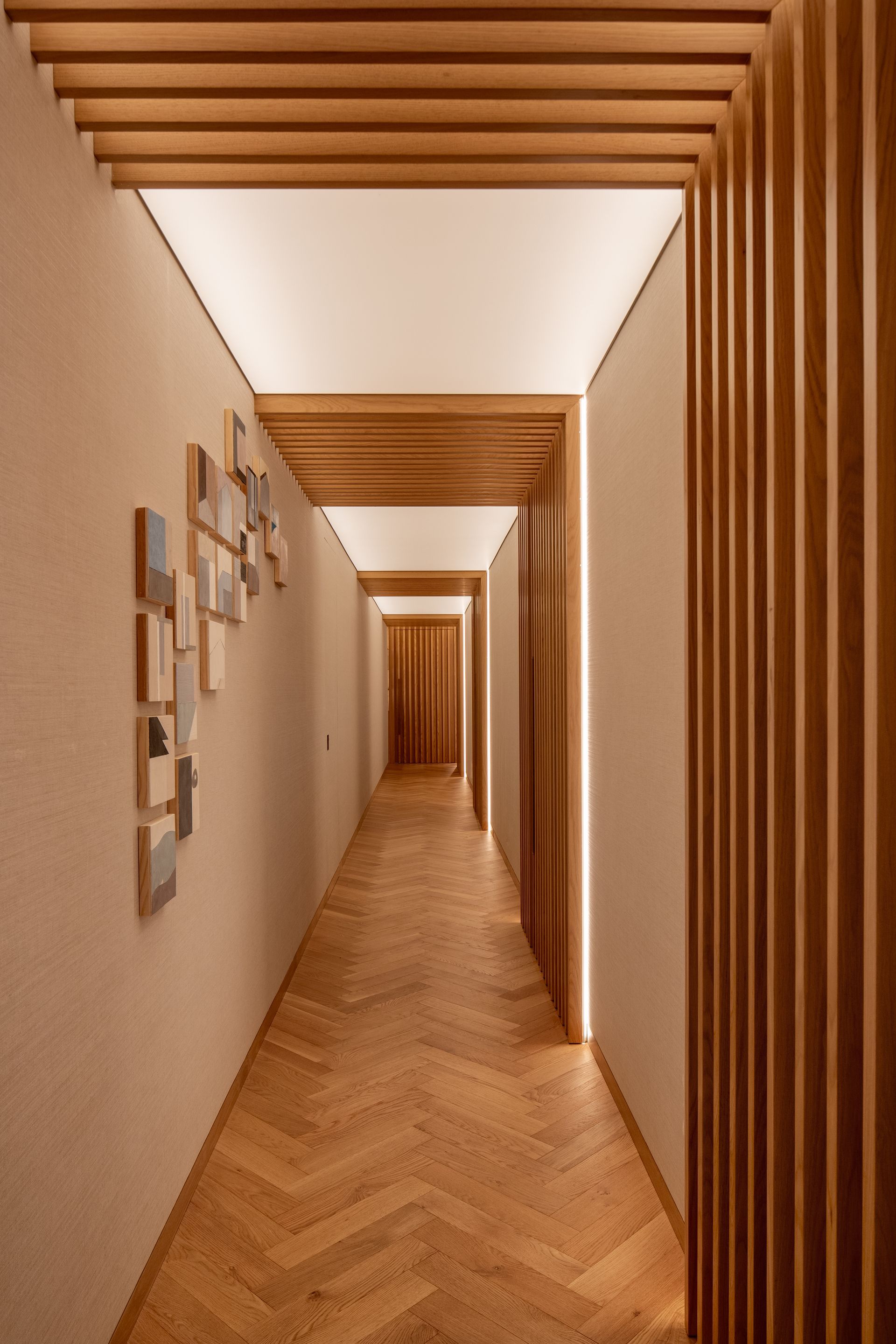
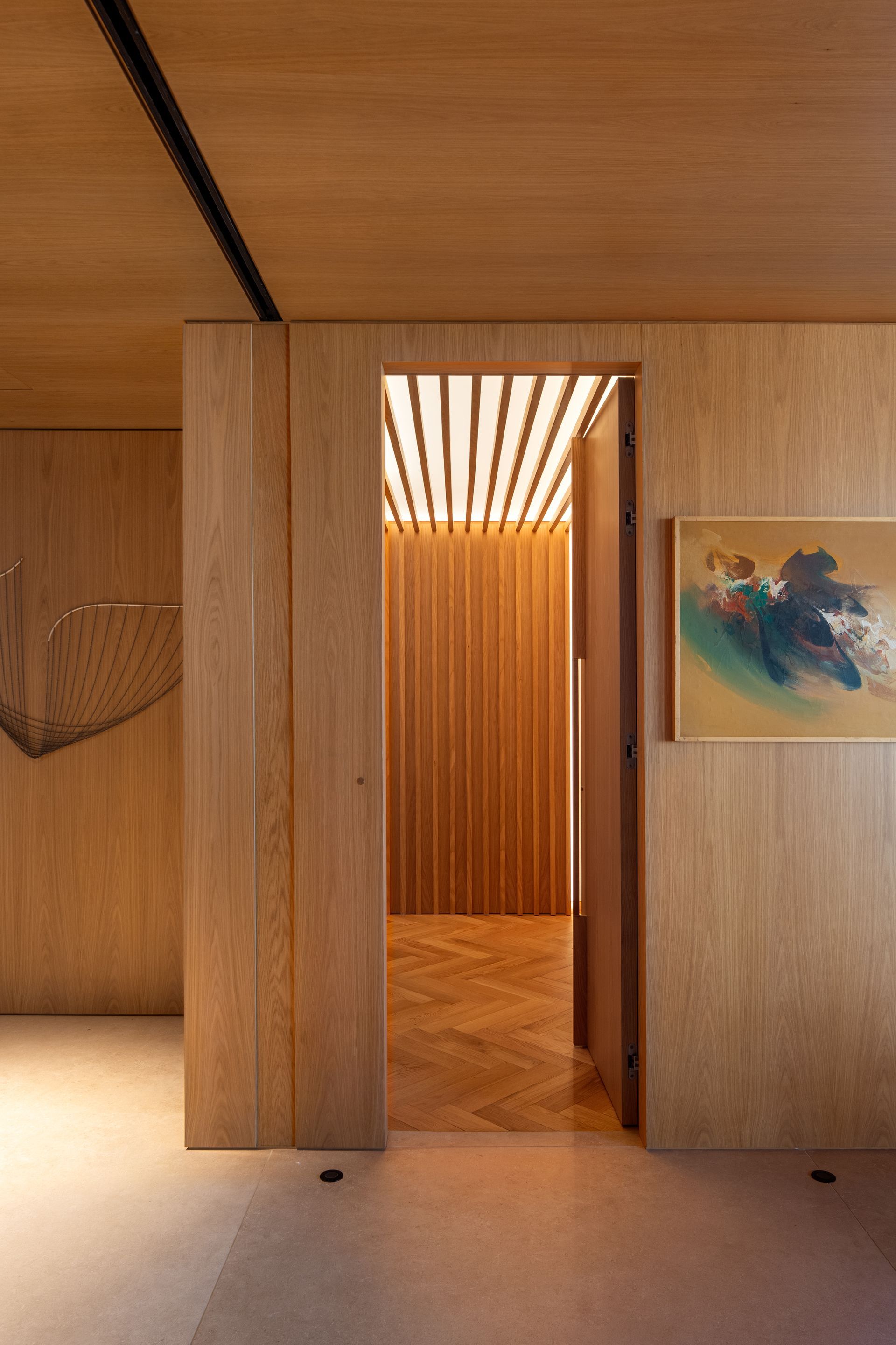
To bring the feeling of natural light into this narrow space, a wooden pergola breaks the monotony, creating rhythm and defining the doors to the office and each of the four bedrooms. A stretched canvas covers the wooden structure, and, with an automation system, the diffused lighting adjusts subtly throughout the day to simulate the circadian cycle. In the morning, the light is soft with a warm color temperature, like sunrise; at noon, it becomes brighter and whiter; and in the afternoon, the light gradually becomes more yellow, simulating the late afternoon sun. This solution helps to gently wake the body or ease the rhythmic intensity toward the end of the day. The walls upholstered in linen, and the floor in the private wing covered with wood parquet in a herringbone pattern.
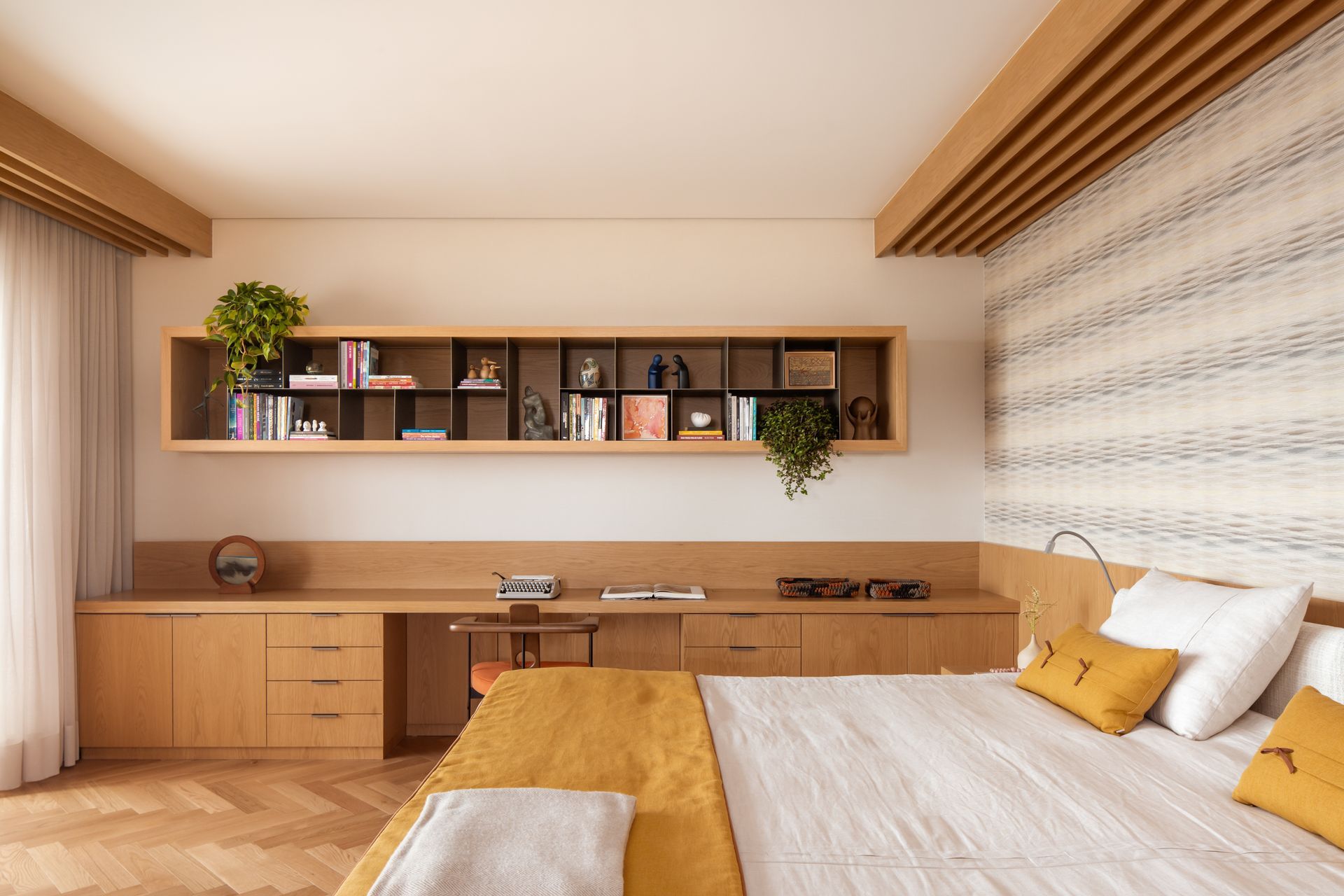
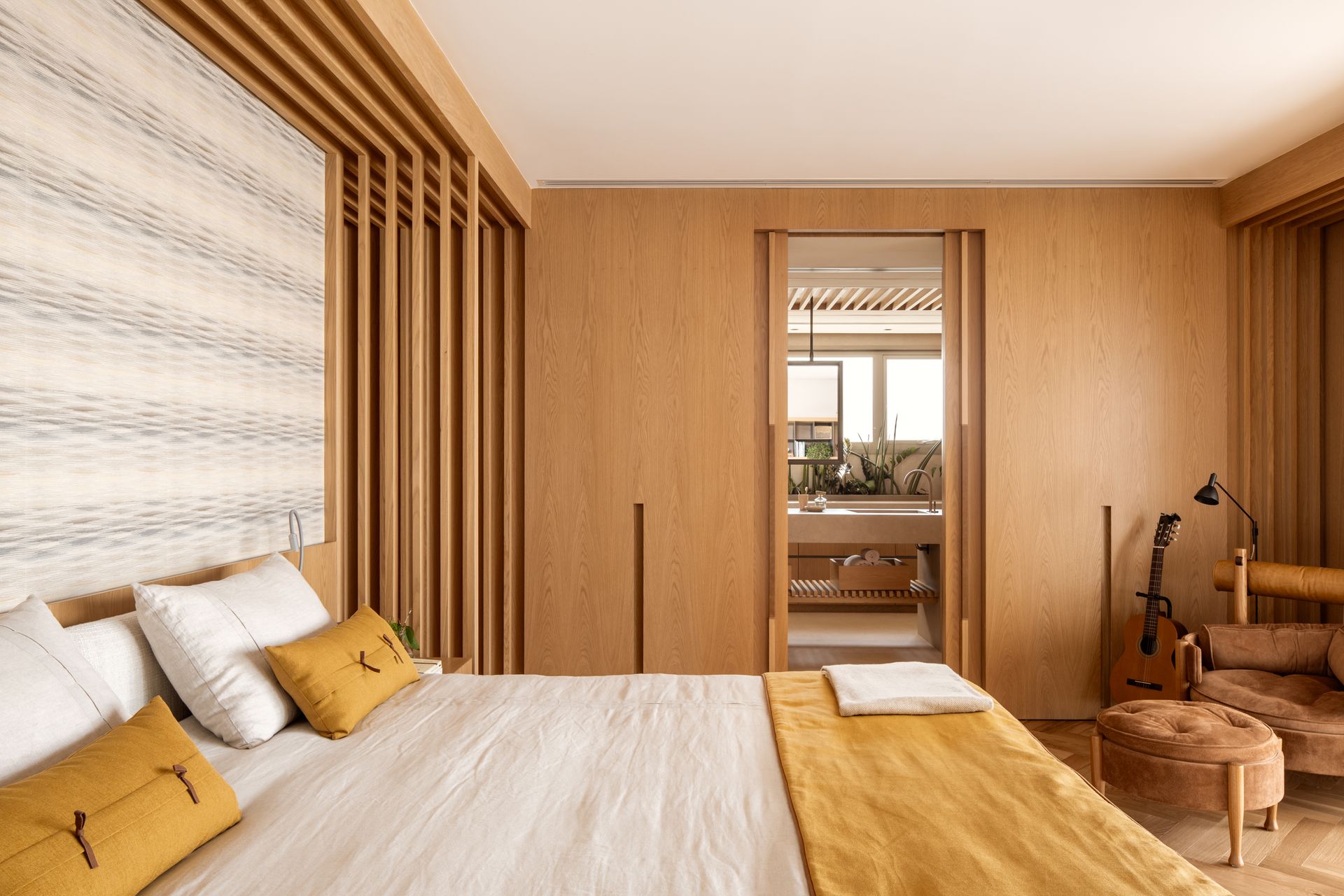
The master bedroom offers an atmosphere focused on well-being. Wooden panels wrap the space, and the headboard extends to the side wall, where the vanity is located. The corridor’s pergola concept maintained on both the entrance and opposite walls, integrating with the curtain rail. Embedded lighting in the niches and headboard provides a diffused light system. The decor complements the tactile comfort with linen bedding and the Vivi armchair and pouf by Sergio Rodrigues (Dpot). The balcony has been adapted into a painting studio, a space dedicated to the resident’s hobby.
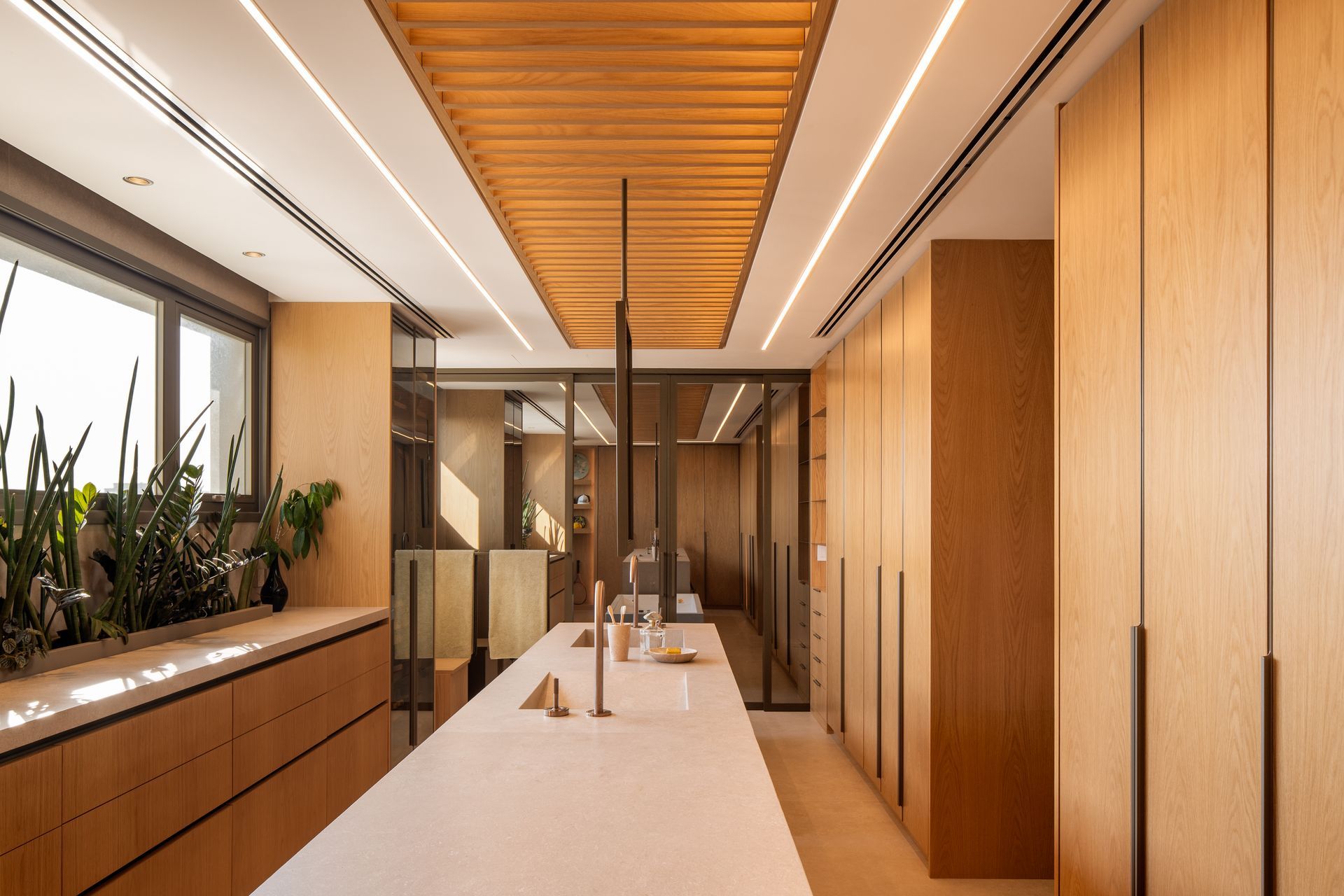
To organize the couple’s individual areas, the small bathrooms and the master suite closet were unified into a spacious integrated bathroom. The cabinetry surrounds the space, and a central countertop accommodates two sinks, with a stone base converted into a bathtub. The suspended mirror adds aesthetic lightness and does not block the flow of light. The toilet and shower cubicles enclosed with full-height glass doors, with a mirrored finish on the outside to maintain privacy.
Photography Carolina Lacaz
Interior Design André Luque Arquitetura
SHARE THIS
Contribute
G&G _ Magazine is always looking for the creative talents of stylists, designers, photographers and writers from around the globe.
Find us on
Latest News
Subscribe
Keep up to date with the latest trends!
Popular Posts